
Brentwood Union School District Budget Newsletter
STATE FUNDING CHANGE IS PROBLEMATIC AT BUSD
The Local Control Funding Formula (LCFF) changed how districts were funded starting twelve years ago. Now, all districts receive a base funding grant for each student who comes to school. Districts receive 20% additional funding per student for each student with high needs, defined as learning English, in poverty, homeless or in foster care. Districts are provided additional money if more than 55% of children in the district qualify as having high needs. As a result of this formula, BUSD receives less money per student than 90% of the districts in the state. If BUSD received the money that Antioch receives per student, we would have over $31 million more to serve our local students. As costs continue to outpace revenue, cuts will eventually be required at BUSD.
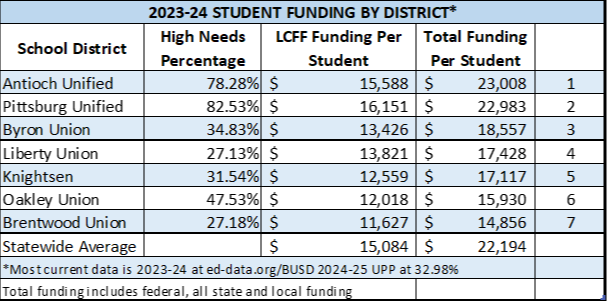
*Most current data is 2023-24 at ed-data.org
**Total funding includes unrestricted and restricted, including federal, other state, and other local funding
***2024-25 BUSD High Needs Percentage 32.96%
ATTENDANCE MATTERS FOR LEARNING AND FUNDING
Until 1999, schools’ count of students was based on attendance, but students with excused absences, mostly due to illness, were added to the count. After Senate Bill 727 was enacted in 1998-99, school districts no longer received funding for students who were absent from school for any reason.
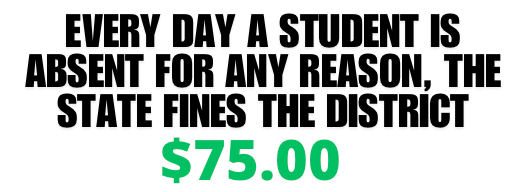
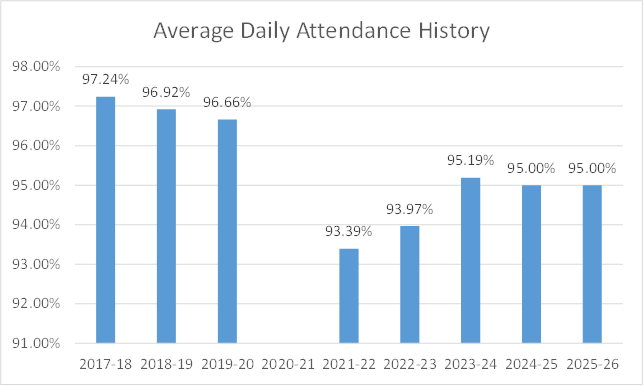
In the years prior to the pandemic, BUSD average daily attendance (ADA) was around 97%, meaning that on any given day 3% of students were not in attendance. Since returning from the pandemic, attendance has been significantly lower. In 2023-24, BUSD ADA was at 95.19%, more than 2% lower. In addition to the negative impact on learning, lower attendancerates means the state subtracts from our funding. Each day a student is absent for any reason, the district is fined approximately $75. California is one of only a handful of states that funds schools this way. A 1% attendance decline results in approximately $1 million less in funding. BUSD lost over $2 million in funding last year due to the post-COVID attendance changes. BUSD is actively working to promote students attending school every day they are not sick. There is clear research about the connection between school attendance and student success.
REQUIRED EXPENDITURES CONSUME LARGE PORTION OF NEW MONEY THAT IS PROVIDED TO DISTRICT
The statutory Cost of Living Adjustment (COLA) provided to districts each year is calculated at the state level. It is not specifically designed to provide schools what they need to keep up with inflation. BUSD’s 2025-26 budget was built on a projected COLA of 2.03%.
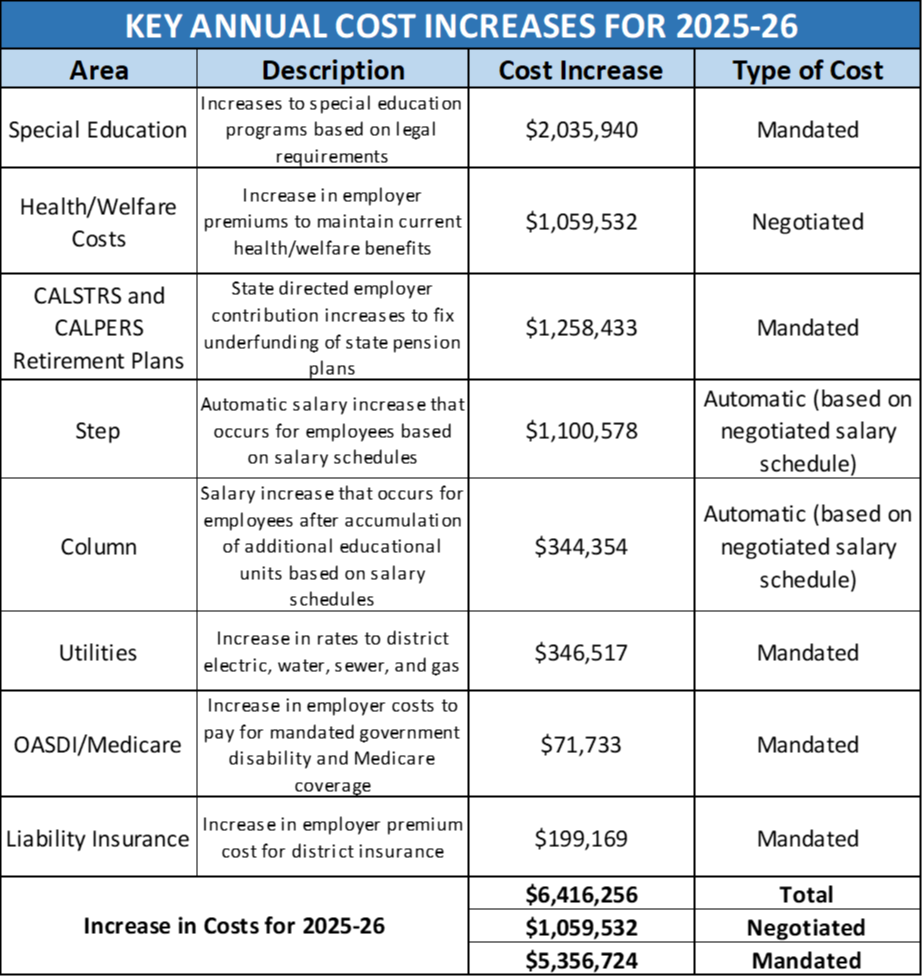
Each year, mandated and automatic increases have to be accounted for in the budget. These are costs that the district incurs without choice. These include state retirement plan increases, special education cost increases, disability and Medicare increases, Insurance premium increases, increases in utility prices, transportation cost increases, as well as step and column increases to employee salaries based on negotiated salary schedules. In addition, districts negotiate with multiple employee groups each year for salary, benefits, and other contractual items that often have additional costs.
Mandated cost increases often outpace revenue increases to the district, causing deficit spending or the need for budget reductions.
SECOND INTERIM BUDGET & MULTI-YEAR PROJECTION OUTLOOK
The Second Interim budget was approved at the March 11, 2026 Board Meeting. The District budget continues to be of great concern due to low funding, concerns with the federal and state budget environment, and increasing expenses. Second Interim assumptions include updated multi-year projections based on the Governor’s Proposed 2026-27 Budget released in January, updated enrollment projections, revenues, and expenditures through January 31, 2026.
Enrollment projections allow the district to plan proactively for staffing and multi-year sustainability. Projections are updated with each Board-approved budget. District 2025-26 enrollment number is certified by the CDE at 10,153 students. Enrollment projections are adjusted for 2026-27 and 2027-28 with a reduction of 49 students and reduction of 74 students, respectively. The fiscal impact is estimated at a reduction of $612,598 in revenue for 2026-27, and a reduction of $955,044 in 2027-28, for a total reduction of revenue of $1.57 million dollars in the next two fiscal years. TK expansion has now occurred, and the kindergarten pipeline is not accelerating. Cohort growth is tapering. A cohort is a group of students who move together from one grade to the next each year. Upper grades are strong, but lower grades are flattening. Housing assumptions increased slightly but did not offset slower cohorts. Softening cohort growth may indicate a gradual enrollment decline over the next five years.
The Governor’s Proposed 2026-27 Budget projects a 2026-27 COLA reduction of 0.61% to 2.41% and a COLA reduction of 0.36% to 3.06% in 2027-28. Second Interim includes a budget reduction of $500,961 for the 2026-27 fiscal year. The reduction includes the elimination of a Curriculum & Instruction Coordinator Position, reducing a one-day week counseling position at Harvest Grove Virtual Academy, reducing the District Receptionist position by 50 work days, pausing Curriculum & Instruction (C & I) stipend committees, professional development, and slowing curriculum adoption material purchases. Due to COLA and enrollment reductions, the 2027-28 projection increases the budget reduction from $500,000 to $1,631,584 to meet the 3% required minimum reserve for 2027-28. This is an increased reduction of $1.13 million dollars.
NEXT STEPS: COLA reductions and lower enrollment will reduce LCFF revenue by an estimated $3.45 million over the next two fiscal years. Special Education program costs continue to rise at an estimated 6.5% or $2 million annually in out years. Governor’s Proposed 2026-27 Budget includes proposed one-time funds. They are not allowed to be included in next year’s projections. 2026-27 Budget includes a Fund 17 balance of $739,339 transferred into Fund 01 to meet 3% required reserve. Second Interim does not include any 2025-26 negotiated salary increases. The state budget remains uncertain and won’t be signed into law until June. The district budget is in critical condition, and the ending fund balance is the lowest in district history. The 2026-27 Budget will be adopted by the Board at the June 17, 2026 Board Meeting.
GOVERNOR'S 2026-27 PROPOSED STATE BUDGET
Governor Newsom released the 2026-27 State Budget Proposal on January 9, 2026. This is the beginning of the State budget process for the next fiscal year which begins on July 1, 2026. Proposition 98 establishes the minimum funding level for K-14 Education. The Governor's 2026-27 Budget proposes to appropriate significantly less in Proposition 98 than his own Administration calculates. This strategy was deployed in January 2025 for $1.9 billion and this year proposes a much larger settle up of $5.6 billion whereby the state refrains from fully appropriating the entire estimated minimum guarantee. This reduction in on-going LCFF revenue has an impact on school district budgets. Included in the 2026 Budget is an estimated statutory cost-of-living adjustment (COLA) of 2.41% This is a decrease of 0.61% from what the Governor projected in the 2025-26 Enacted Budget in June 2025. The Governor’s proposal includes the use of one-time Proposition 98 funds for a discretionary block grant. Allowable uses are consistent with the 2025 Discretionary Grant received in the current year. More information is needed regarding the allocation methodology. If the block grant is distributed using the same approach as the current year, on a per-ADA basis, then the estimated amount is $500 per ADA. The Budget also provides additional repayment to the Learning Recovery Emergency Block Grant from when it was reduced in 2022. The Budget includes an increase in COLA to Special Education and Nutrition Services, and again fully funding the Universal Meal Program which provides free breakfast and lunch to all students. There is also a proposed increase in Special Education to accomplish equalization for Base Rates and proposed increase to the Expanded Learning Opportunity Program for Rate 2.
The State continues to be confronted with structural operating deficits. It projects a deficit of roughly $22 billion in the 2027-28 fiscal year and shortfalls in the two following years. In May, the Governor releases the May Revision which includes updated state revenues, expenditures, and reserve estimates based on the latest economic forecast. By June 30, the Governor signs the Budget Bill into law.